
Guide to Writing Good Research Questions
Guide to Writing Good Research Questions
Behind every strong research study lies a strong question — a clear, focused prompt that directs what you’re trying to understand and why it matters. Research questions act as the compass of a project. They determine the shape of the methodology, the type of data you collect, and the insights you eventually uncover. When the question is vague or biased, the entire study becomes blurry. When the question is sharp, the findings come into focus.
Yet writing good research questions is often trickier than it seems. Many researchers, especially beginners, fall into traps: asking questions that are too broad, too leading, or impossible for respondents to answer. This guide explores how to craft questions that set your research up for success — questions that are clear, purposeful, and capable of guiding meaningful inquiry.
Why Good Research Questions Matter
The clarity of a research question influences every stage of a study. When the question is well-defined, it becomes easier to choose a method, whether that means a deep qualitative interview or a large-scale survey. A precise question also helps minimize bias by forcing you to articulate exactly what you want to understand instead of drifting into vague territory.
Most importantly, a well-written question ensures the insights you gather are truly useful. Stakeholders can follow the logic from question to data to conclusion. The research becomes defensible — and the insights become actionable.
What Makes a Research Question Strong
Good research questions tend to share a few core qualities. They are written simply and directly, even when the subject matter is complex. They focus on a specific behavior, perception, or motivation rather than trying to cover too much at once. They avoid leading respondents or implying a “right” answer. And they always tie back to the research’s goals — each question must exist for a reason.
A strong question is also realistic. It asks something respondents can reasonably recall, evaluate, or describe. Questions that rely on long-term memory or speculative thinking often lead to unreliable data. The best questions invite honest, thoughtful responses based on what people actually experience.
Different Types of Research Questions
Research questions vary depending on what the study aims to uncover. Some questions are exploratory, meant to dig into people’s attitudes, frustrations, or deeper motivations. These often appear in early-stage qualitative research. Others are descriptive, designed to measure behaviors or characteristics — for example, how frequently someone purchases a product or how satisfied they are with a service.
Comparative questions appear when you want to understand differences between groups or preferences across options. Diagnostic questions dig into the reasons behind a choice, probing the “why” behind consumer behavior. And predictive questions look ahead, helping researchers understand likely future actions such as intent to purchase or willingness to recommend.
Each type has its place, and understanding which one your study requires makes it much easier to craft the right wording.
Common Mistakes to Avoid
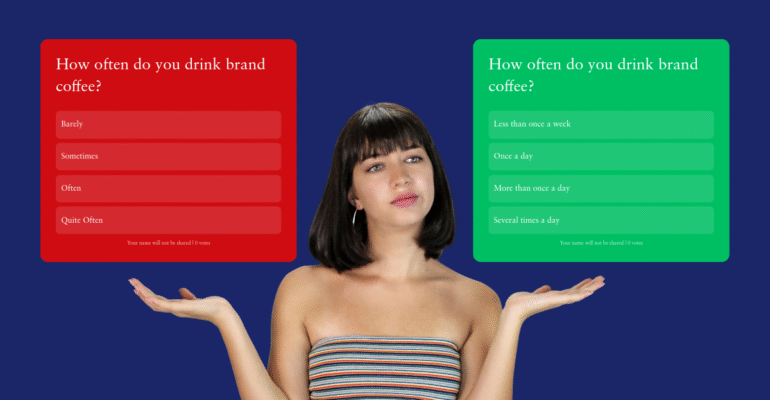
Even small missteps in how a question is written can distort results. Leading questions, for example, subtly push the respondent toward a particular answer (“Don’t you think…?”). Double-barreled questions ask two things at once, forcing respondents to choose an answer that might only match half of what’s being asked. Other pitfalls include using ambiguous words like “regularly,” assuming respondents understand technical terms, or asking questions that force people to guess about things they don’t recall clearly.
Avoiding these mistakes is just as important as knowing what to include. A poorly written question doesn’t just weaken the data — it can mislead decision-makers entirely.
How to Craft Stronger Questions
The process of writing good research questions begins with clarity about your research objectives. What decision is this research meant to support? What information do you need to collect to make that decision confidently? Write your questions to reflect that purpose.
From there, simplicity is key. Short sentences, familiar language, and single-focus questions help respondents understand what you’re asking. If you’re designing a survey, think about how the questions flow together; group related topics so respondents aren’t jumping around mentally. And before finalizing your instrument, test it. A short pilot run often reveals issues you didn’t notice — confusing instructions, missing answer options, or questions that respondents interpret differently than intended.
Balancing open-ended and closed-ended questions is also important. Open-ended questions provide depth and nuance, while closed-ended ones provide structure and measurability. The right mix depends on your goals.
Examples of Clear, Effective Questions
A behavioral question might simply ask how many times a respondent visited a store in the past month. An attitudinal one might explore how satisfied they were with their most recent experience. Preference questions help determine which features matter most, while perception questions explore how trustworthy or innovative a brand feels. Intent questions, such as likelihood to recommend, help forecast future customer behavior.
Though varied in purpose, these questions all share the qualities of clarity, focus, and neutrality.
Conclusion
Writing good research questions may seem like a small part of the research process, but it is truly foundational. A well-crafted question sharpens your entire study, making insights more reliable and more powerful. Whether you’re conducting an academic project, a brand study, or a customer experience survey, the ability to write clear, meaningful research questions is one of the most valuable skills you can develop. Done right, it turns research into a tool for understanding — and understanding into a tool for smarter decisions.
Download Our Latest Panel Book